


PU Tactile Manufacturer in Punjab
Introduction
Founded in 2023, AS Enterprise is a Rajkot, Gujarat–based company dedicated to manufacturing high-quality accessibility and safety products. With a modern production facility and a skilled technical team, we ensure every product meets the highest standards of precision, durability, and performance.
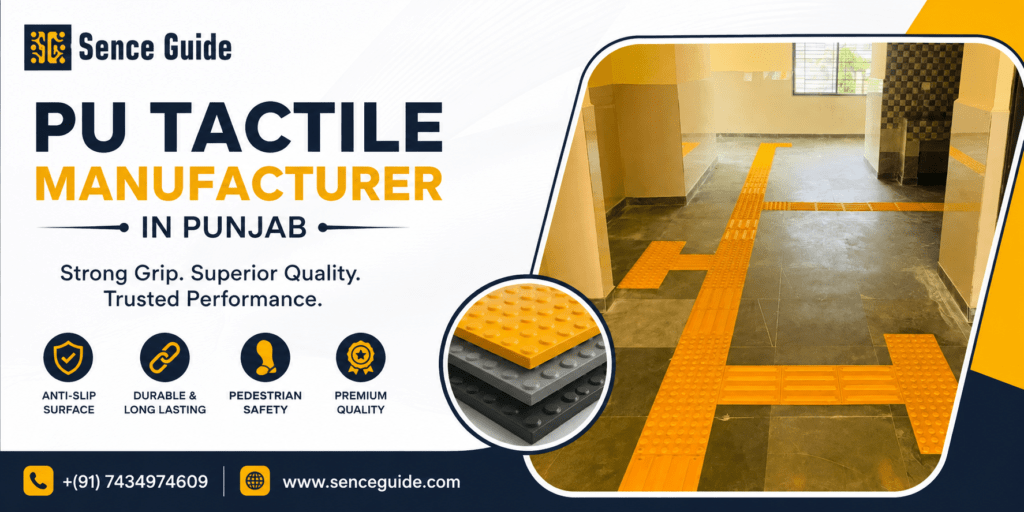
Finding a reliable PU TACTILE MANUFACTURER in PUNJAB is important for businesses, contractors, architects, and infrastructure developers looking for safe, durable, and high-quality tactile products. Tactile indicators are designed to help people identify pathways, obstacles, entrances, stairs, platforms, and other important areas through touch and visual recognition. PU tactile products are increasingly used in commercial buildings, public areas, transportation facilities, industrial premises, walkways, and other locations where safety and accessibility are important. These products provide a tactile surface that helps people identify pathways, hazards, stairs, platforms, and other important areas through touch and visual recognition. We are the best PU Tactile Supplier.
AS Enterprise is a reputable producer and supplier of PU tactile goods in Punjab that provides long-lasting solutions for various commercial, industrial, public, and accessible applications. The company offers tactile products appropriate for contemporary flooring and accessibility projects, with an emphasis on high-quality materials, accurate manufacturing, and customer requirements. Tactile indicators can help people identify pathways, hazards, changes in direction, stairs, platforms, and other important areas. Depending on the application, they can be available in different shapes, sizes, patterns, colours, and surface designs.
What Are PU Tactile
PU tactile products are tactile indicators manufactured using polyurethane (PU), a strong and flexible material known for its durability and resistance to regular wear. These products are installed on floors and pathways to create detectable patterns that can be recognised by touch, especially with a cane or through footwear. The raised patterns or indicators provide a physical reference that can be detected by touch. They can also create a visible contrast with the surrounding floor, making them useful for improving navigation and safety. We are the best PU Tactile Exporter.
PU tactile indicators can be available in different shapes, sizes, colours, and surface patterns depending on the application. Their flexible material properties make them suitable for areas where long-term performance and comfortable surface integration are important. Compared with ordinary materials, PU offers useful properties such as flexibility, impact resistance, and resistance to regular wear. This makes PU tactile products suitable for areas that experience frequent pedestrian movement.
Why Choose AS Enterprise
1. High-Quality PU Material
- A professional PU tactile manufacturer focuses on using quality polyurethane material to manufacture tactile tiles, strips, and studs. PU provides a useful combination of flexibility, strength, impact resistance, and durability. Unlike rigid materials that may crack under certain stresses, polyurethane can offer better resilience for high-footfall environments.
2. Better Accessibility and Safety
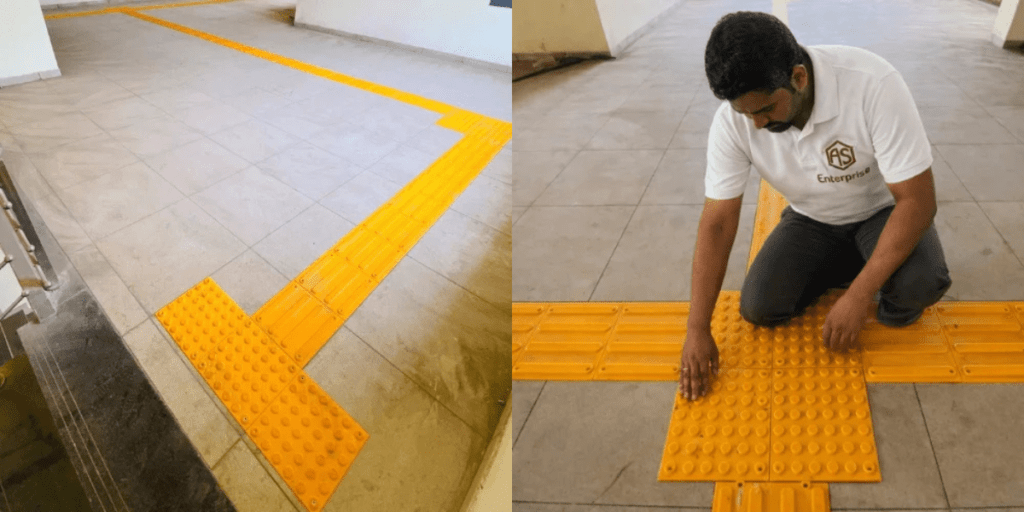
- PU tactile tiles help create accessible pathways by providing detectable warning and directional information. Warning patterns, generally featuring raised dots or domes, can indicate hazards or changes in direction, while directional patterns with raised bars can help guide users along designated pathways. By installing these tactile indicators correctly, infrastructure developers can create safer and more inclusive environments for visually impaired pedestrians.
3. Suitable for Indoor and Outdoor Applications
- One major advantage of PU tactile products is their versatility. They can be installed in both indoor and outdoor environments, including footpaths, railway platforms, metro stations, airports, hospitals, malls, offices, educational institutions, and public buildings. PU tactile products are commonly marketed with weather-resistant, UV-resistant, and anti-slip properties for demanding applications.
4. Easy and Fast Installation
- Many PU tactile products are available with self-adhesive fixing systems. This can make installation considerably faster because selected products can be applied without extensive drilling, demolition, or reconstruction of the existing floor. Peel-and-bond installation is particularly useful for renovation and retrofit projects where the existing surface needs to remain intact.
5. Multiple Fixing Options
- A reputed PU Tactile Manufacturer in Punjab can offer different fixing options according to the application. Depending on the product and surface, options may include tissue tape, foam tape, butyl tape, or mechanical fixing using washers and screws. This flexibility allows contractors and project engineers to select a suitable installation method based on the substrate, traffic conditions, and expected service life.
6. Durable Performance in High-Traffic Areas
- Public infrastructure experiences continuous pedestrian movement, making durability an important consideration. Quality PU tactile tiles are designed to withstand regular foot traffic while maintaining their raised tactile patterns. Their flexibility and resistance to environmental exposure make PU a practical choice for demanding accessibility applications.
7. Anti-Slip Surface
- Safety is another important reason to select quality PU tactile products. Properly designed tactile surfaces can provide useful grip while simultaneously delivering tactile information. Anti-slip properties are especially valuable in areas where users may encounter moisture, frequent cleaning, or heavy pedestrian traffic.
8. Customised Solutions for Different Projects
- Every infrastructure project has different requirements. A reliable manufacturer can provide tactile solutions in different patterns, dimensions, colours, thicknesses, and installation configurations. Customisation can be particularly useful for large commercial, railway, airport, institutional, and government projects where standard products may not always meet the complete project specification.
9. Professional Technical Support
- Buying directly from a manufacturer can also provide access to technical knowledge. Manufacturers can help customers select the appropriate tactile pattern, fixing method, product configuration, and quantity according to the project requirements. For large projects, technical assistance can help contractors avoid incorrect product selection and installation problems.
10. Cost-Effective Accessibility Solution
- Self-adhesive PU tactile systems can provide an economical alternative for upgrading existing floors because installation can be completed without extensive floor demolition. This makes them useful for accessibility improvements in already-developed buildings and public spaces. For bulk infrastructure projects, purchasing directly from a PU Tactile Manufacturer in Punjab can also provide advantages in terms of bulk production, consistent quality, customisation, and supply planning.
11. Consistent Product Quality
- Working directly with an established manufacturer can help maintain consistency across large orders. Uniform dimensions, tactile patterns, color, thickness, and finishing are important when installing tactile pathways over large areas. Consistent manufacturing also helps contractors achieve a professional appearance throughout the project.
12. Suitable for Major Infrastructure Projects
- PU tactile products are used for accessibility pathways in various public and commercial environments. Applications include railway stations, metro stations, airports, hospitals, malls, footpaths, offices, educational institutions, corporate campuses, and government buildings. Punjab-based manufacturing can also be advantageous for projects requiring supply to Punjab and nearby North Indian markets because it can support efficient coordination, bulk dispatch, and project-specific requirements.
13. Compliance-Oriented Manufacturing
- Accessibility projects often require products that align with applicable project specifications and accessibility guidelines. Some PU tactile manufacturers market products as compliant with standards or guidelines such as ISO 23599 and CPWD-related barrier-free requirements. When selecting a manufacturer, buyers should verify the exact certifications, test reports, technical specifications, and compliance documentation required for their particular project rather than relying only on general claims.
14. Long-Term Value
- A tactile pathway is an investment in accessibility and safety. Selecting durable PU tactile products can reduce the frequency of replacement and maintenance while helping maintain a consistent guidance system for users. For architects, contractors, builders, facility managers, and infrastructure developers, choosing a dependable manufacturer can therefore contribute to better project performance over the long term.
Applications of PU Tactile Tiles
1. Railway Stations and Platforms
- PU tactile tiles are widely applicable around railway stations and platforms to help visually impaired passengers identify safe walking routes and hazardous areas. Directional tactile patterns can guide pedestrians along designated pathways, while warning patterns can indicate platform edges, staircases, crossings and other potential hazards. Tactile indicators are commonly used in railway and metro infrastructure for accessibility purposes.
2. Metro Stations
- Metro stations require clearly defined pedestrian routes because of their high passenger movement. PU tactile tiles can be installed along concourses, platforms, entrances, exits, stairways and interchange areas. Directional tactile strips help establish a continuous route, while warning tactile surfaces can highlight areas requiring additional attention.
3. Airports
- Airports are large public facilities where accessibility and easy navigation are essential. PU tactile tiles can be used along passenger walkways, terminal entrances, corridors, waiting areas, boarding zones and other pedestrian routes. Their tactile patterns provide additional navigational cues for visually impaired travellers. Airports are among the common applications identified for PU tactile systems.
4. Footpaths and Pedestrian Walkways
- PU tactile tiles are particularly useful on public footpaths and pedestrian walkways. Directional tactile indicators can establish a recognisable walking route, while warning indicators can be positioned near crossings, stairs, intersections and other changes in pedestrian movement. In Punjab’s urban areas, tactile pathways can contribute to a more inclusive streetscape and public-space development.
5. Hospitals and Healthcare Centres
- Hospitals receive visitors with different mobility and accessibility requirements. PU tactile indicators can be installed along corridors, entrances, reception areas, waiting zones and pathways connecting important departments. The tactile guidance system can help visually impaired visitors move more independently through unfamiliar surroundings. Hospitals and healthcare facilities are recognised applications for PU tactile tiles.
6. Schools and Educational Institutions
- Schools, colleges, universities and training institutions can incorporate PU tactile pathways to make their campuses more accessible. Tactile indicators can be installed between entrances, classrooms, administrative areas, libraries, laboratories, playgrounds and other important locations. This is particularly valuable when developing inclusive educational infrastructure that can accommodate students, teachers and visitors with visual disabilities.
7. Shopping Malls and Commercial Complexes
- Shopping malls, retail centres and commercial buildings have high pedestrian traffic and multiple entrances, corridors and level changes. PU tactile tiles can provide tactile guidance through these spaces, while warning indicators can identify stairs, escalators and other potential hazards. Their availability for applications such as malls and commercial facilities makes them suitable for modern accessibility-focused construction projects.
8. Government Buildings
- Government offices and public service buildings can use PU tactile tiles to improve accessibility for visitors and employees. They can be installed at entrances, reception areas, corridors, staircases and designated pedestrian pathways. For Punjab’s public infrastructure projects, tactile indicators can form part of a broader barrier-free accessibility strategy.
9. Bus Stops and Bus Terminals
- Bus stops and terminals are important locations for tactile guidance because passengers need to navigate between footpaths, waiting areas and boarding points. PU tactile tiles can help define walking routes and identify specific warning zones. Tactile products are also used around bus stops and other public transportation facilities.
10. Pedestrian Crossings
- PU tactile warning indicators can be installed near pedestrian crossings to provide a detectable change in the walking surface. This can help visually impaired pedestrians recognise important transition or decision points along an accessible route. The combination of directional and warning patterns allows tactile pathways to communicate different types of information through surface texture.
11. Corporate Offices and Business Parks
- Modern corporate offices and business parks can integrate tactile pathways into their accessibility infrastructure. PU tactile tiles can be used in reception areas, entrances, corridors, parking-to-building pathways and other common areas. Their durable polyurethane construction and availability in self-adhesive or mechanical fixing configurations can make them practical for different flooring surfaces and installation requirements.
12. Smart City and Urban Development Projects
- Smart city projects increasingly focus on accessibility, pedestrian safety and inclusive urban design. PU tactile tiles can be incorporated into pedestrian walkways, public plazas, transit areas, government facilities and other high-use public spaces. Their application in smart infrastructure projects is already established within the Indian tactile-products market.
Specification Table of PU Tactile
| Parameter | Specification |
|---|---|
| Material | PU Tactile |
| Product | Polyurethane (PU) |
| Type | Tactile Indicator / Stud |
| Surface | Anti-Slip / Textured |
| Shape | Round / Custom |
| Colour | Yellow / Black / Custom |
| Application | Accessibility & Wayfinding |
| Installation | Adhesive / Mechanical Fixing |
| Features | Durable, Weather-Resistant, Anti-Slip |
| Usage | Indoor & Outdoor |
| Customization | Size, Shape & Colour Available |
Types of PU Tactile
1. PU Tactile Studs
- PU tactile studs are small raised tactile indicators installed on floors to provide warning information. They are commonly placed near staircases, platform edges, ramps, crossings, and other potentially hazardous areas. Their compact design makes them suitable for creating warning patterns without significantly affecting the appearance of the flooring.
2. PU Tactile Strips
- PU tactile strips are elongated tactile indicators used to create directional or guiding pathways. They can help visually impaired individuals follow a specific route through a building or public area. These strips are commonly used in corridors, stations, commercial buildings, airports, and other locations where guided movement is required.
3. Directional PU Tactiles
- Directional tactiles are designed to guide pedestrians along a particular route. They usually feature raised linear patterns that provide a detectable direction. They are useful in large public spaces where visitors need to move from one location to another safely and independently.
4. Warning PU Tactiles
- Warning tactiles are designed to indicate a change or potential hazard ahead. They can be installed before staircases, ramps, crossings, platforms, entrances, and other areas requiring additional awareness. The raised surface allows users to detect the warning zone through touch or a mobility aid.
5. PU Tactile Tiles
- PU tactile tiles combine tactile patterns with a larger flooring format. They can be installed as part of an accessibility pathway and are available in different patterns and dimensions. They are suitable for commercial and public infrastructure projects where a complete tactile surface is required.
Conclusion
PU tactiles are an important part of modern accessible infrastructure. They help create safer and more convenient pathways for visually impaired people by providing detectable directional and warning information. Their durability, flexible design options, and wide range of applications make them suitable for public buildings, transportation facilities, commercial spaces, educational institutions, hospitals, and pedestrian areas. We are the best PU Tactile Exporter in Rajkot.
If you are looking for a reliable PU Tactile Manufacturer in Punjab, AS Enterprise can provide practical PU tactile solutions for different accessibility requirements. From tactile studs and strips to warning, directional, adhesive, and customised products, the company offers options designed for a variety of projects. Choose AS Enterprise for dependable PU tactile products and help create safer, more accessible spaces for everyone.